

Here’s how to annotate a book: read a short section, mark a detail you want to return to, and add a reason or question. Keep a page or chapter reference with the note, then review it when you continue reading, discuss the book, or use it for an assignment.
Book annotation means recording your responses beside the passages that prompted them, or in notes that point back to those passages. You can annotate books with a pencil, a notebook, or tools you already use; an elaborate kit is optional.
Choose your purpose and where to keep notes
For pleasure, you might record a surprise, a funny line, or a detail that changes how you see a character. For school, start with the assignment’s questions and requirements. For a book club, keep passages that could support an interesting discussion—not just a list of events.
Choose a method that suits the copy you have and the reading experience you want.
| Your copy | Where to keep the notes | What to retain |
|---|---|---|
| An ordinary copy you own and are happy to mark | Pencil notes in the margins, or another method you prefer | The passage and a short reason for marking it |
| A borrowed, fragile, valuable, or unmarked copy | A separate notebook or document | Title, edition, chapter, page, and a short passage locator |
| An ebook in an existing reader | That reader’s available note features, or an external notebook | A chapter or location reference if page numbers change |
| An authorized PDF you can annotate | A compatible PDF reader; optional Chrome workflow below | Readable source text and the actual saved annotated copy |
Can you write in the book?
Mark only a copy you own and are willing to alter, or one you have permission to annotate. For a library, borrowed, or valuable book, use notes elsewhere rather than assuming pencil or removable products are acceptable.
On an ordinary owned copy, sticky notes can hold a longer response when there is little room. Page tabs can locate a passage, but a tab alone does not tell you why it matters. Keep the explanation on the note or in your notebook.
Are removable notes safe for every book?
No. The Canadian Conservation Institute’s book-care guidance warns that sticky notes can leave adhesive residue. Do not treat “removable” as a guarantee for fragile or valuable paper. For those copies, use a separate notebook and a suitable bookmark rather than experimenting on the pages.
Do you need a color key?
Color coding is optional. You might use one label for a character detail, another for a question, and a star for a line you want to revisit. If you prefer different colors, make their purpose simple enough to remember.
On sticky notes, words and symbols should carry the meaning even without the color. “Why does she keep the key?” is more useful later than a yellow flag whose meaning you have forgotten. Follow an instructor’s required system when one is given.
What should you mark in fiction and nonfiction?
Look for a passage’s role, not merely its apparent importance. The useful note depends on what kind of book you are reading and what you plan to do with it.
| Kind of passage | What to notice | A useful response |
|---|---|---|
| Fiction: a character’s words and actions | A contradiction, change, repeated object, or revealing choice | “She says she is leaving, but keeps something that could let her return.” |
| Nonfiction: a claim or explanation | Main ideas, evidence, conditions, and limits | “What supports this claim, and which people or situations does it cover?” |
| An unfamiliar word or concept | Its meaning in this context | A brief definition, or a question to resolve before interpreting the passage |
| Favorite quotes or striking language | What you enjoy or want to remember | A personal reason, such as “The comparison makes this ordinary room feel unfamiliar.” |
For a hypothetical nonfiction claim such as “Longer opening hours improve access,” a note could ask who uses the extra hours and what “access” means. That question tests the claim; it does not establish that the claim is true or false.
You do not need to label every technique or collect the same number of notes from every chapter. Annotating books can be light and selective.
Read, mark, explain, and return
Read a short section before marking
Let the passage develop before deciding where to stop. A paragraph, scene, or longer section may be the right unit. If constant marking interrupts the reading experience, read through first and return to the key points afterward.
You can take notes at a natural pause rather than after every sentence. There is no required reading speed or percentage of marked text.
Mark the smallest useful passage
Choose enough words to preserve the meaning, including any condition or qualification. Underline or highlight an owned copy if that suits you, place a note in the margins, or record the locator elsewhere.
A highlight can be enough to find favorite quotes again. An explanation is especially helpful when you expect to discuss the passage or use it as evidence. Sticky notes can carry that explanation on a copy you are comfortable using them in; they do not replace checking whether the page should be marked at all.
Write a reason, question, or connection
State what you noticed in your own words, whether in the margins or in a notebook. “Her action conflicts with her promise” gives you something to investigate. “Important” leaves the work for later.
Keep uncertainty visible. A note that asks “Does this suggest she wants to return?” should not become “She wants to return” unless later evidence supports it. Connections should name what links the passages, not just say that one reminded you of another.
Retain the chapter, page, and edition. For an ebook with changing pagination, use a location marker or a short distinctive phrase alongside the chapter. That makes a note useful even when someone else’s copy has different page numbers.
Pause at a chapter boundary
Write a short recap of what changed, which main ideas matter, and what remains unclear. Compare it with earlier notes: has a new scene answered a question, or changed your interpretation?
The UNC Learning Center’s annotation guide recommends purposeful questions and notes in the reader’s own words. Use that principle to decide which marks you need to keep, rather than treating a full page of annotations as the goal.
What if everything seems worth marking?
Return to your purpose. For discussion, choose a point you could explain and a question you could ask. For a specific assignment, identify the passage that helps answer it. You can revisit other details later. If several sticky notes repeat the same reaction, combine the thought instead of adding another flag for every occurrence.
What does a useful annotation look like?
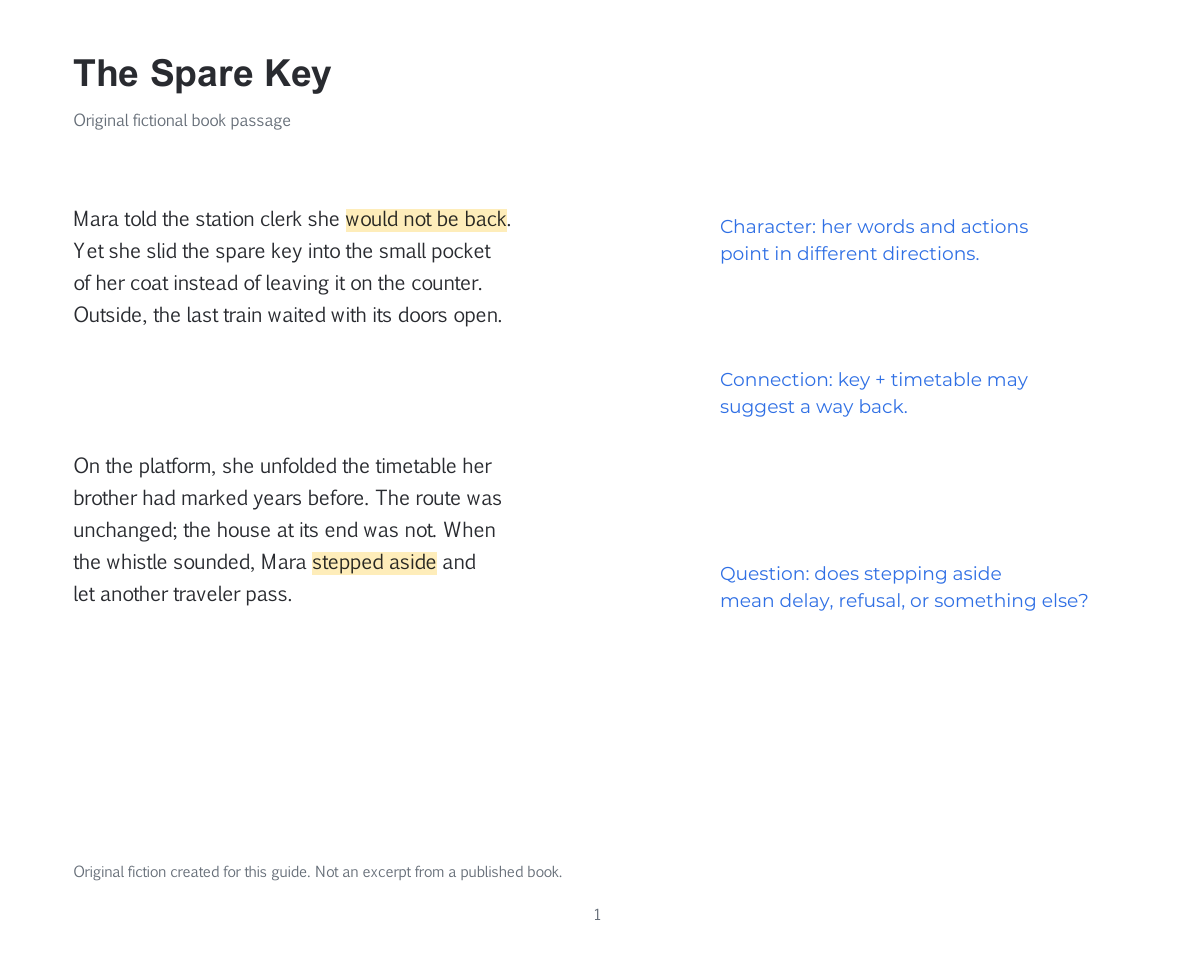
The Spare Key is an original fictional passage created for this guide. It is not an excerpt from a published book or a real event. The downloadable teaching sample places both paragraphs on page 1.
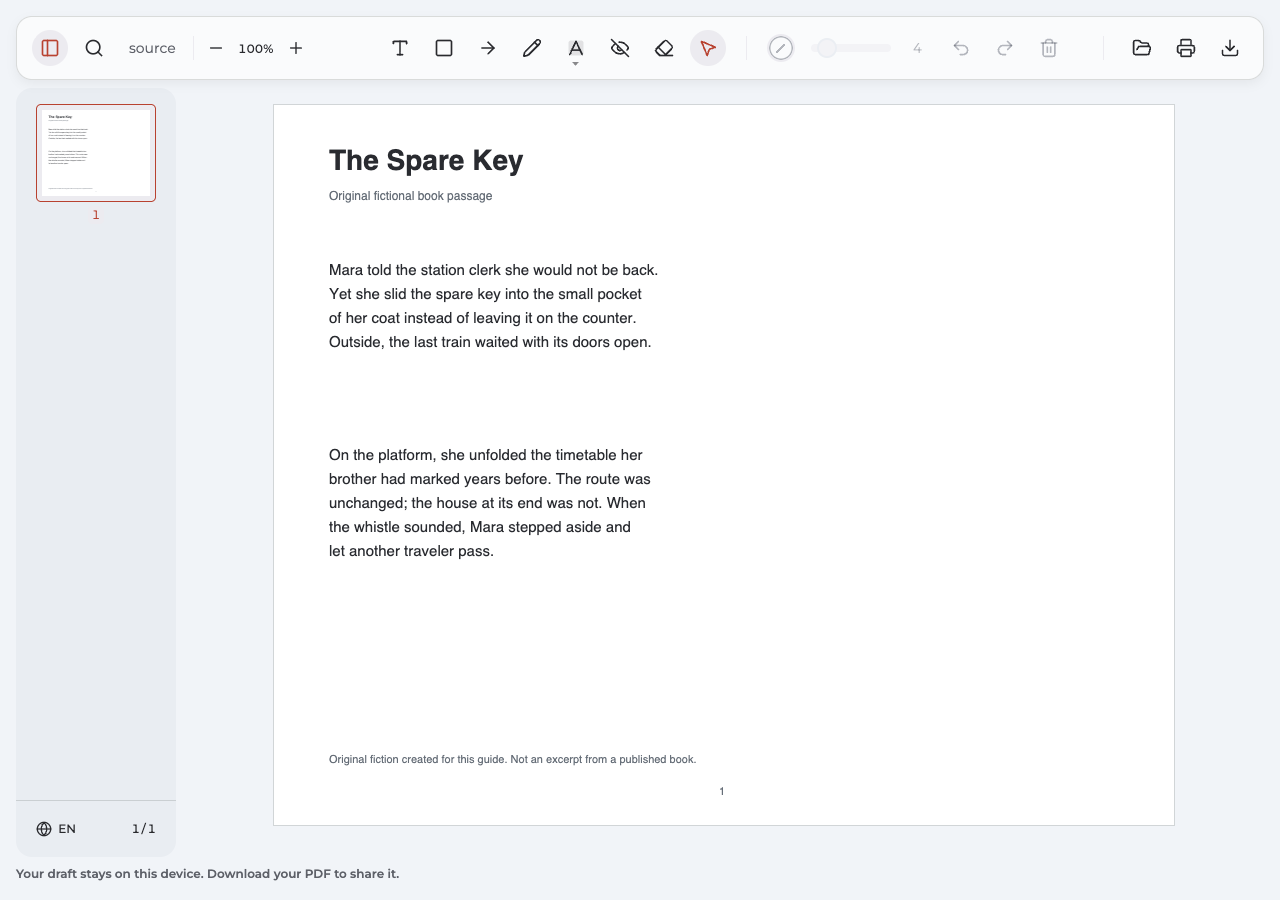
Mara told the station clerk she would not be back. Yet she slid the spare key into the small pocket of her coat instead of leaving it on the counter. Outside, the last train waited with its doors open.
On the platform, she unfolded the timetable her brother had marked years before. The route was unchanged; the house at its end was not. When the whistle sounded, Mara stepped aside and let another traveler pass.
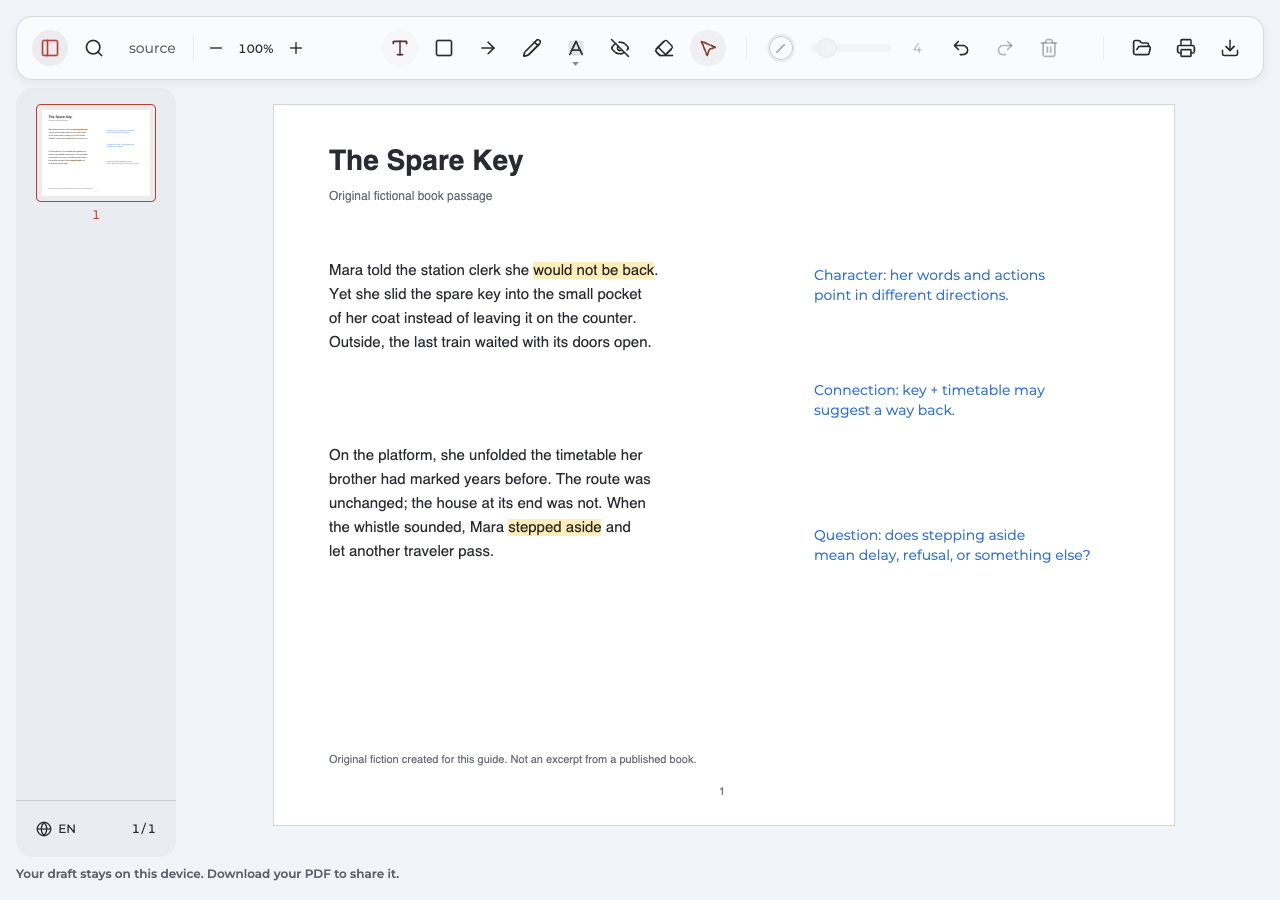
The sample highlights “would not be back” and “stepped aside.” Its three notes connect those details with a possible reading and a remaining question.
| Exact note | Passage it connects to | Why it helps |
|---|---|---|
| Character: her words and actions point in different directions. | Mara says she will not return, then keeps the spare key. | Records a tension without claiming to know her motive. |
| Connection: key + timetable may suggest a way back. | The retained key and the old timetable. | Connects two details while keeping the interpretation tentative. |
| Question: does stepping aside mean delay, refusal, or something else? | The final action on the platform. | Preserves the uncertainty instead of inventing what happens next. |
A possible interpretation is that Mara’s declaration is less settled than it sounds: she keeps objects associated with a route back, yet her final action remains unresolved. That reading can guide a discussion, but it does not prove that she returns home, boards the train, or reunites with anyone.
Could the same details support another reading?
Yes. Keeping a key might reflect habit or attachment rather than a plan to return. Stepping aside could mean hesitation, refusal, or simply allowing another person past. Compare those possibilities with the exact wording. An excerpt this short cannot establish a complete character arc; later chapters would be needed to test what changes over time.
How to annotate a book for a class or book club
For a class, follow the required focus, citation style, and annotation format. For a reading comprehension task, check whether you can explain a passage accurately before judging it. Your own reaction and the narrator’s account are not interchangeable.
For a discussion, bring a plausible claim, its passage, and a question or alternative. Using our example, you might say: “The retained key makes Mara’s departure seem uncertain. Does the final action strengthen that reading, or could she simply be letting someone pass?”
That gives others something specific to examine. A personal response is welcome too: explain which detail produced it rather than presenting it as the book’s only possible meaning.
Keep a simple discussion check: Can you find the passage, explain the note, distinguish evidence from a guess, and identify what would change your view? When people use different editions, name the chapter and opening words as well as the page.
Want to keep your notes in a PDF?
Use a PDF workflow only when you already have an authorized, supported PDF and it suits your task. A physical book, EPUB, or Kindle title does not automatically become a compatible file. An existing reader may already provide what you need; conversion is not a prerequisite for annotating.
The optional example below uses Annotate PDF, an installed desktop Chrome extension that processes PDFs locally. It does not import Kindle or EPUB books, provide OCR, or supply a cloud research library.
Open and mark the passage
Keep an original copy, then open the PDF file. Choose Highlight (H) and drag across selectable words. In the example, the two highlighted phrases locate the contradiction and the uncertain final action.
Choose Text (T) to add the three visible notes in the margins beside the paragraphs. Keep the source legible and adjust Font size if needed. The sample uses size 14 for its two-line notes; that is a layout choice, not a required setting. No arrow is needed because each note is already close to its passage.
How do I correct my own mark?
Choose Select (V) and select your annotation to move or edit it. Use Delete selected annotation for an unwanted mark, or Undo for a recent change in the current session. Supported own exports with intact annotation data can restore their marks for editing, but earlier Undo history does not return. Foreign comments and flattened page artwork are not guaranteed editable.
What if the PDF is a scan and the words will not select?
Use an original text-based PDF if one is available to you, or a separate OCR-capable workflow when word selection is necessary. On a supported scan, positioned Rectangle, Pen, or Text marks can add visual feedback without recognizing the pictured words. Annotate PDF does not edit the source wording. Its Select tool works on its own annotations and pans the page; it is not a source-text copying command.
Export and reopen the copy
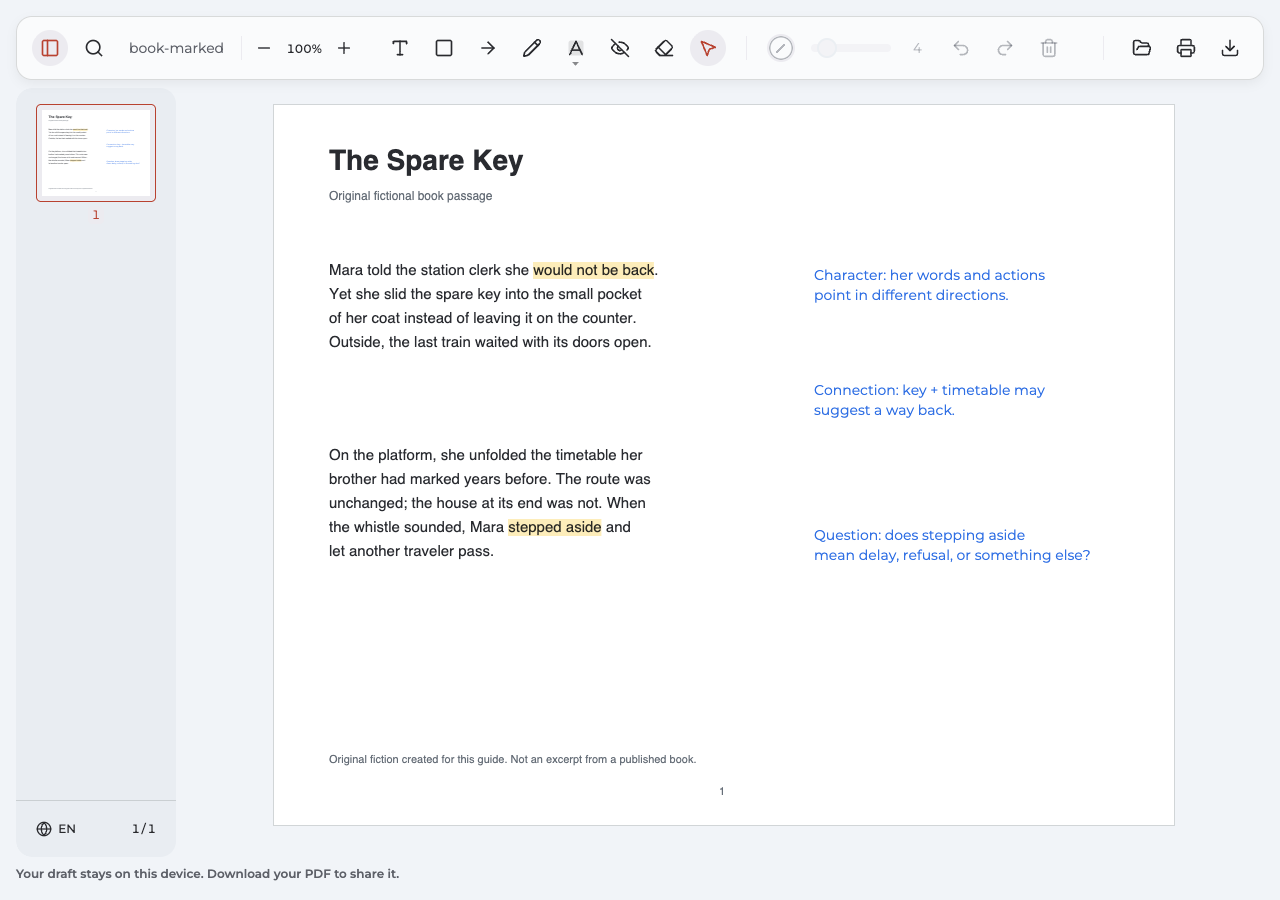
Choose Export to download the annotated PDF file. Open that actual download and check the full paragraphs, complete notes, and correct locations. Keep or send this version rather than an earlier attachment.
A recoverable local draft is not an independent backup. Save the exported result where you can find it alongside the source and your other reading notes.
Compare the original fictional passage with the exported annotated passage.
What should I inspect in the saved example?
Check that the connection note still says “may suggest,” and that the final note remains a question. Those words preserve the limits of the interpretation. The full passage should remain readable, with no note covering the source.
Questions about book annotation
Must every page have an annotation?
Only if your assignment requires it. Otherwise, mark passages that serve your purpose. A chapter with few notes may simply have raised fewer questions or contained fewer details you wanted to revisit. More marks do not by themselves show a better reading.
How can I find useful notes later?
Keep a short index by chapter or topic. Add a page or location and a few words describing why the passage matters. If you use page tabs or sticky notes, connect their locations to that explanation; a row of flags without reasons is harder to use later.
What if there is no room beside the text?
Use a brief locator in your notebook rather than squeezing in an unreadable comment. On an ordinary owned copy where you choose to use sticky notes, keep them from covering the passage you need to read. For borrowed or delicate books, retain the no-mark notebook route described above.