

Here’s how to annotate poetry: read for the situation, mark a specific word, sound, or line choice, and add a short note about its possible effect. Reread the surrounding lines to test your interpretation rather than treating the first idea as a final answer.
Poetry annotation is the process of recording observations, questions, and possible meanings beside the words that prompted them. Paper, a notebook with line references, and a PDF can all work. Follow the assignment’s requirements; otherwise, use a system that keeps your reasoning readable.
How do you annotate a poem step by step?
Read for the situation before marking
Read the poem once without trying to label everything. Who appears to be speaking, to whom, and about what? What literally happens, if anything? Some poems explore an image or thought rather than tell a story.
The speaker is the voice within the poem, not automatically its author. Keep the two separate unless you have evidence for connecting them. Your initial reading can leave questions open.
If suitable, read the poem out loud to hear its movement. Listening to an available reading or reading silently are valid alternatives. The Academy of American Poets’ reading guide emphasizes returning to a poem and asking questions of its language and form. You do not need to solve every uncertainty on the first pass.
Mark language and add a reason
Notice a word choice that changes how you see the scene. Check unfamiliar vocabulary in context: a dictionary gives possible senses, but it does not decide what an image must symbolize.
Figurative language presents something through comparison or another departure from literal description. A metaphor treats one thing as another; personification gives something nonhuman a human quality. Naming these literary devices is a starting point, not the explanation.
For example, “A bus sighs” gives a vehicle a human action. A useful note asks whether that sound makes this particular scene feel tired, quiet, or something else—and which nearby details support the reading.
Teacher David Rickert’s approach puts understanding and questions before collecting labels. Mark the feature that matters, then explain why you noticed it.
Listen to sound and examine the lines
Look at the structure of the poem: line lengths, stanza divisions, punctuation, and repeated patterns. Read the grammar naturally, then notice how the printed lines arrange it.
A rhyme scheme records a pattern of end sounds when one exists; do not force a poem without regular end rhyme into a pattern. Rhythm is its heard movement, while meter is a recurring pattern of stresses—not simply a syllable count.
Alliteration repeats initial consonant sounds; assonance repeats vowel sounds. These poetic devices matter when you can connect the repetition to emphasis, pace, contrast, or another effect in the passage.
Should I pause at the end of every line?
There is no universal rule. A sentence can continue beyond a line ending, a feature called enjambment. First follow the syntax so you understand the sentence, then try hearing what the break emphasizes or delays. A line ending is not automatically a full stop, but it can still shape attention. Preserve the original line breaks when quoting or saving the poem.
Track shifts and test an interpretation
Notice a change in time, action, address, or language. A stanza break may accompany a shift, but it does not guarantee one.
Tone is the speaker’s apparent attitude; mood is the atmosphere or effect experienced by a reader. “I feel uneasy” records a personal reaction. To argue that the tone is uneasy, identify the words and actions that support that description.
Ask questions when a detail resists your interpretation. A topic such as separation is not yet a claim about the theme of the poem. Develop a possible statement from the details, while keeping alternatives and unresolved points visible.
Review the notes for your next task
Read the poem again with your notes beside it. Check neighboring lines for a qualification you missed. Replace an overconfident conclusion with a more precise one where necessary.
A useful note can follow this flexible pattern: exact words → observation → possible effect or question. Annotating a poem prepares evidence for poetry analysis; every margin note does not need to be a polished essay sentence.
What does an annotated poem look like?
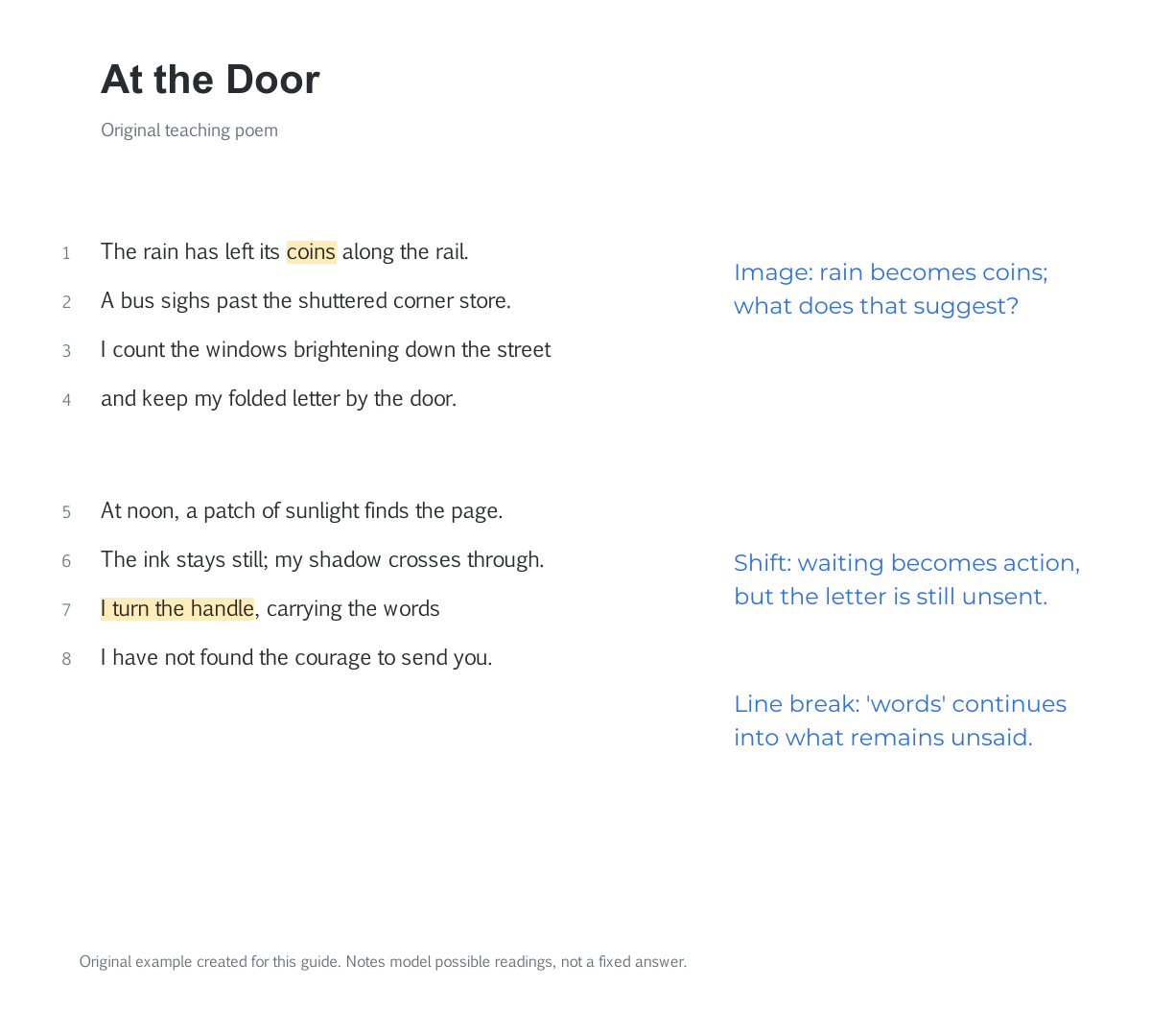
At the Door is an original teaching poem created for this guide. It is not a quotation from a published poet or an account of a real personal event. The notes model possible readings, not a fixed answer.
1 The rain has left its coins along the rail.
2 A bus sighs past the shuttered corner store.
3 I count the windows brightening down the street
4 and keep my folded letter by the door.
5 At noon, a patch of sunlight finds the page.
6 The ink stays still; my shadow crosses through.
7 I turn the handle, carrying the words
8 I have not found the courage to send you.
| Line or phrase | Model margin note | What the note helps investigate |
|---|---|---|
| Line 1: “coins” | Image: rain becomes coins; what does that suggest? | The image may suggest roundness, reflected light, or value. The question leaves room to test those possibilities against the scene. |
| Line 7: “I turn the handle” | Shift: waiting becomes action, but the letter is still unsent. | The hand moves, but line 8 still describes words the speaker has not found the courage to send. Action does not establish a completed delivery. |
| Lines 7–8: “words / I have not found…” | Line break: 'words' continues into what remains unsaid. | Ending line 7 on “words” briefly leaves their status open; line 8 supplies the qualification. |
The first note names an image without assigning it a compulsory meaning. The second connects a change in action with a limit on what we know. The third explains the line break instead of stopping at the label “enjambment.”
One possible reading is that the speaker moves from waiting toward possible contact, while the unsent words leave resolution uncertain. Line 4 keeps the folded letter by the door; lines 7–8 combine a physical movement with continued hesitation.
Could the ending mean something different?
The movement might suggest determination beginning to emerge. Another reader may emphasize that courage is still lacking. Both readings need to account for the handle turning and the final qualification. “The speaker definitely mails the letter” goes further than the text: no sending is shown. Likewise, a brighter setting at noon does not prove that fear has disappeared.
What could I note about the sounds?
The end words “store” and “door” rhyme, as do “through” and “you.” Those pairs occur in corresponding positions in the two stanzas. Notice the pattern before deciding what it contributes: it might connect the physical scene with the addressed “you,” but that interpretation still needs the rest of the poem. Not every line rhymes, so do not describe the whole piece as consecutive rhyming couplets.
How can you annotate a poetry PDF and keep the notes?
Use paper or an existing reader if it already suits your task. For a poem on a live webpage, use a suitable webpage tool or obtain an authorized PDF copy. If you save a page as PDF, check the title, author information, line endings, and stanza spacing before starting.
The optional workflow below uses Annotate PDF in desktop Chrome. It processes PDFs locally on your computer. It is not a poem-analysis generator, OCR tool, research library, or cloud-sync service.
Open a copy and highlight the phrase
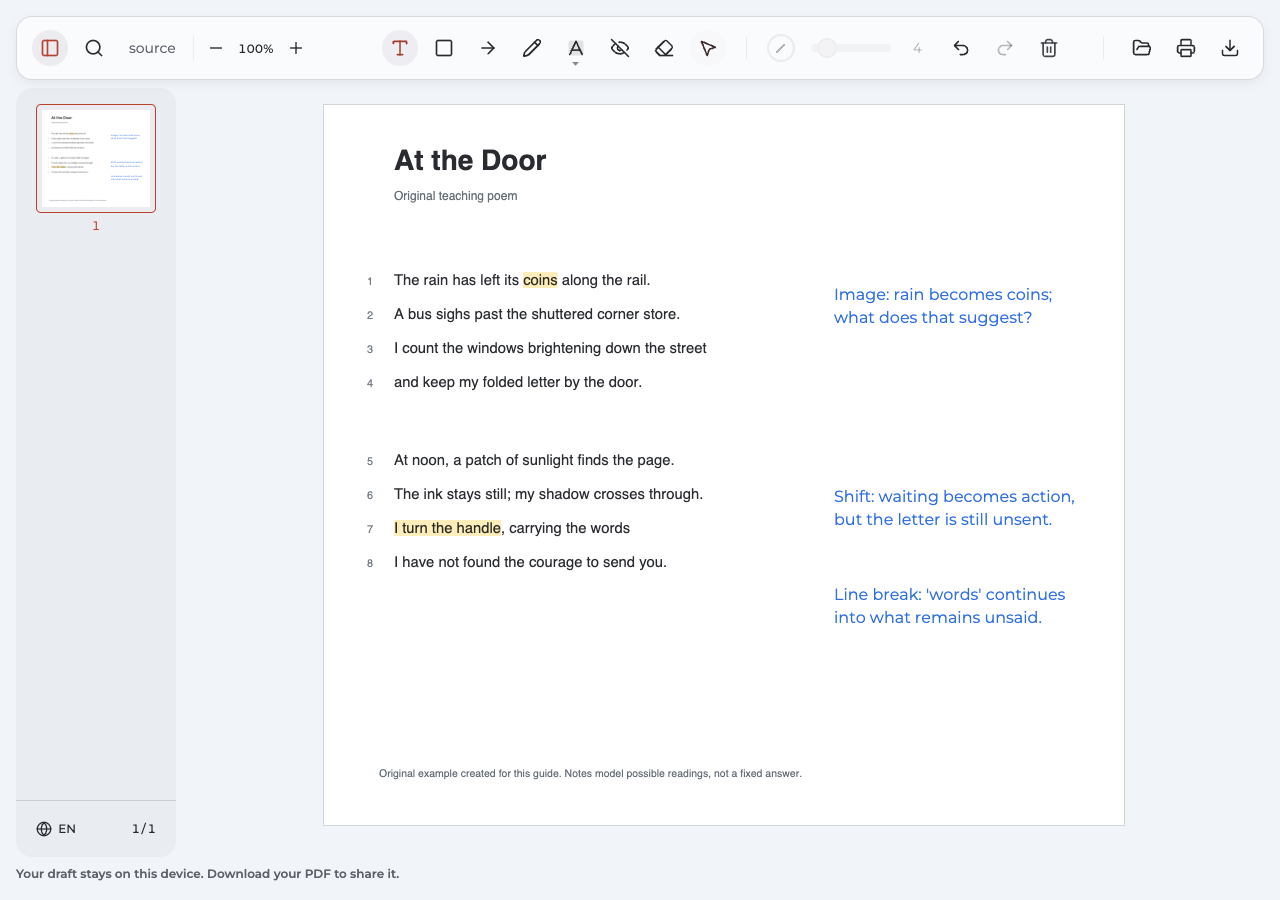
Open the PDF and choose Highlight (H). Drag across a small passage of selectable text. The example highlights “coins” in line 1 and “I turn the handle” in line 7 because the notes explain those exact choices.
Keep the poem’s layout intact. A long colored block is less helpful when it obscures which words prompted your observation.
What if the poem is a scan?
An image-only page may not contain selectable words. Positioned Rectangle, Pen, or Text annotations can add visual notes to a supported scan, but they do not recognize its words. Use OCR elsewhere if text selection is required, then check the exact punctuation and line layout. Select (V) in Annotate PDF selects its own annotations and pans the page; it is not a command to copy the original poem.
Add readable notes beside the lines
Choose Text (T) and place the note in the margins where there is room. Keep it close to the relevant line without covering source text. If space is limited, use a short line reference and put the fuller explanation in clear space elsewhere.
Adjust Font size or color for legibility. In this example, two yellow highlights locate passages and three blue notes explain them. That color choice is optional; the wording carries the meaning.
How do I correct a misplaced note?
Choose Select (V) and select your own note to move or edit it. Use Delete selected annotation to remove an unwanted mark, or Undo for a recent change in the current session. Supported exports with intact annotation data retain their own editable marks. This does not make arbitrary foreign comments or flattened poem text editable.
Export and reopen the copy
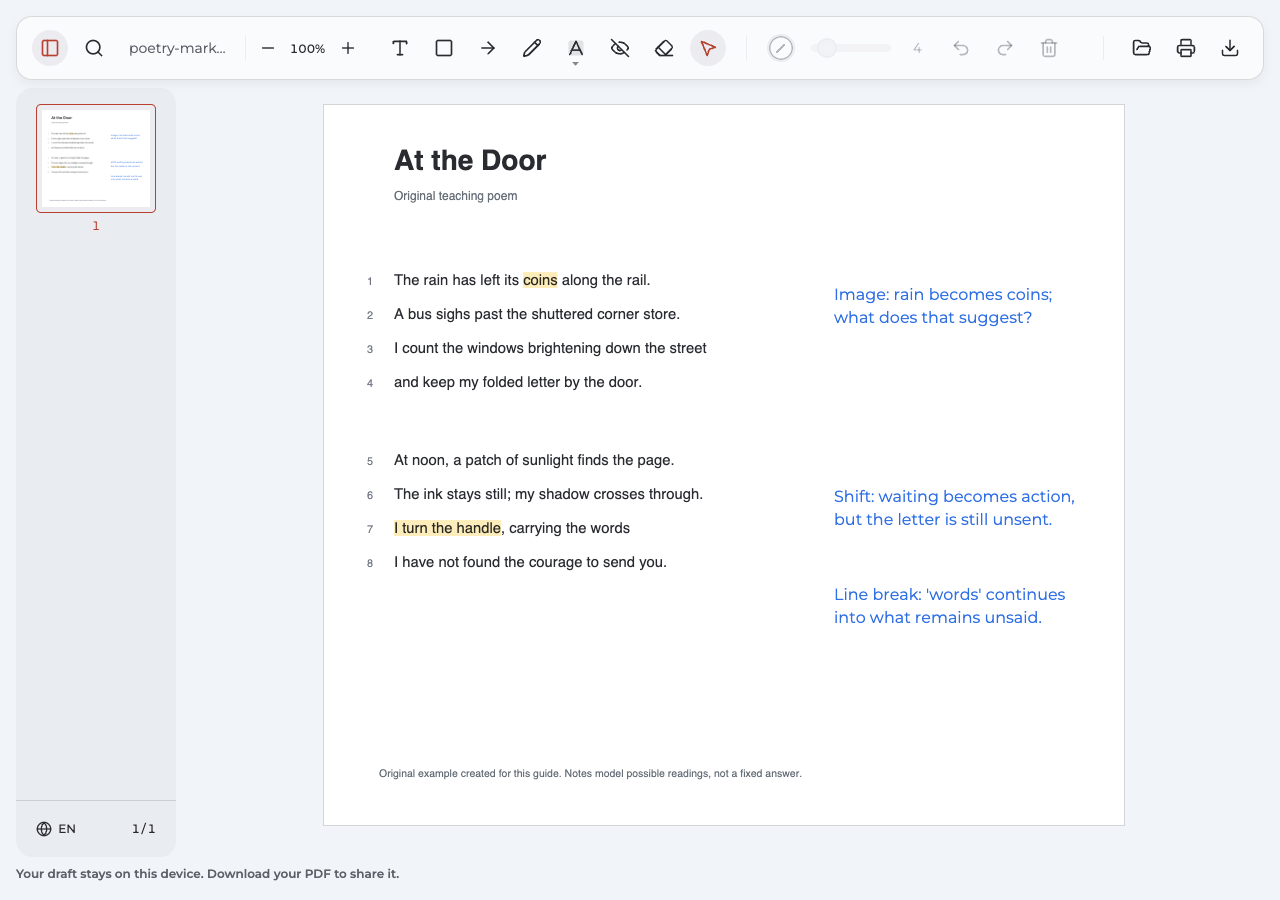
Choose Export, then open the actual download. Read the poem in that saved copy and check all eight lines, the stanza gap, and the complete notes. Make sure no annotation covers the source and that the file you submit is the one you inspected.
Reopening a supported own export restores its annotations, not the earlier session’s Undo history. Keep an independent saved copy rather than treating a recoverable local draft as your only backup.
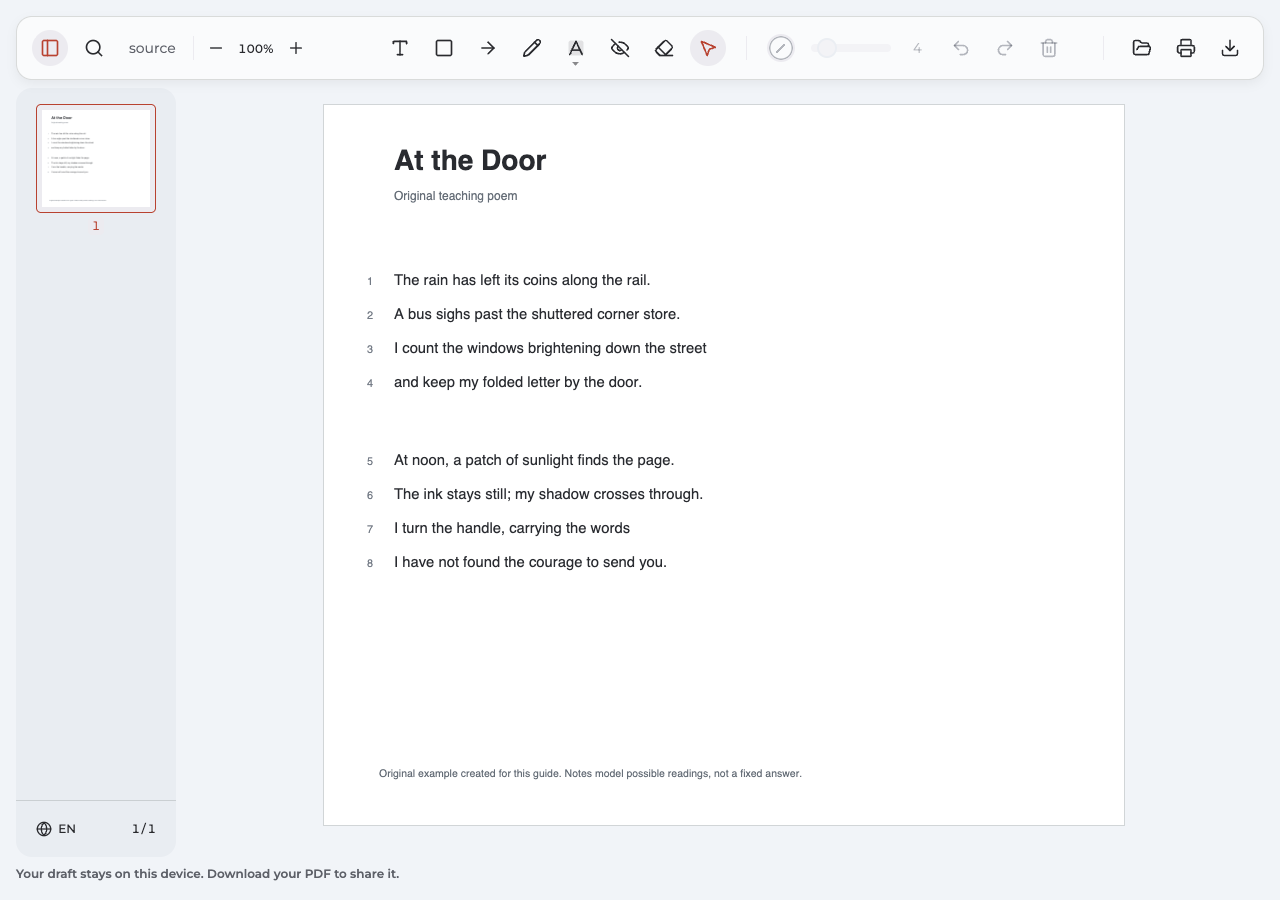
Compare the original teaching poem with the exported annotated poem.
What should I look for in the saved example?
Check that “coins” still connects to the image question, and that the note about action retains its qualification: the letter is still unsent at this point. Then read the poem’s final two lines across their original break. The exported copy should preserve both the exact words and the reasoning attached to them.
How to annotate poetry for an essay or class discussion
Choose one observation and develop a claim, evidence, and reasoning. Keep the line locator and distinguish a plausible interpretation from a fact the poem explicitly states.
For example: The ending presents movement without confirming resolution. In line 7, “I turn the handle” changes the speaker’s earlier waiting into action. Yet line 8 describes words the speaker has not found the courage to send. The break therefore lets an action begin while leaving communication uncertain.
That paragraph explains how details work together. It does not claim to know the author’s private feelings or what happens after the final line.
| Common mistake | A useful repair |
|---|---|
| Highlighting without an explanation | Add what the detail suggests or the question it raises. |
| Listing device names | Explain the effect of one feature in its specific context. |
| Treating the speaker as the poet | Refer to the speaking voice unless evidence supports a biographical connection. |
| Making a confident claim without supporting lines | Locate the words, test a competing reading, and retain the uncertainty. |
| Crowding the page or changing its line breaks | Move notes into clear space and compare the saved version with the original. |
Before discussion or submission, check the source title and author, exact quoted words, line reference, explanation, and any qualification. Follow your assignment’s quotation and citation instructions when working with real poems.
How much should I annotate?
Follow any required number or type of notes. Otherwise, choose enough observations to support your next task and explain why each mark is there. There is no universal quota per line or page, and marking everything can make useful distinctions harder to find.
Can I annotate without knowing technical terms?
Yes. Start with a precise observation such as “The sentence continues after the line ends” or “This word gives the bus a human action.” Learn the term when it helps describe what you noticed. An accurate explanation matters more than an impressive label used incorrectly.
What if my interpretation differs from a classmate’s?
Compare the evidence each reading explains. Ask which details challenge your view and whether a qualification would improve it. Different interpretations can be defensible, but they still need to account for the words on the page; a preference alone is not textual support.